Building Better Digital Maps: A Comprehensive Guide to Road Elements Parts Icons Sets
In the rapidly evolving world of digital design, visual communication is paramount. Whether you are developing a navigation app, creating an infographic about urban planning, or designing a website for a logistics company, the clarity of your visuals can make or break the user experience. At the heart of many successful transportation and infrastructure projects lies a specific, often overlooked asset: the Road Elements Parts Icons Set. This collection of flat illustration vector icons serves as the fundamental building block for representing the complex network of roads that connect our world.
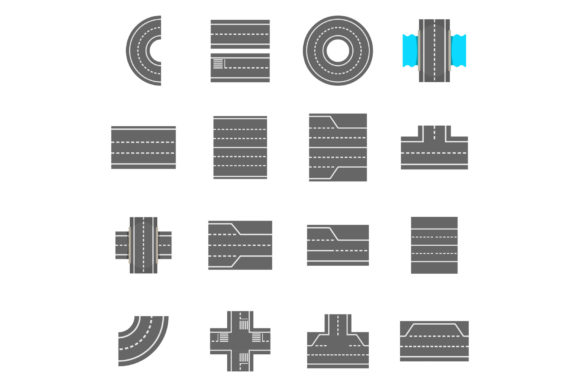
For designers, developers, and content creators, understanding the value and versatility of these icon sets is crucial. A high-quality set typically includes around 16 distinct road elements, meticulously crafted to represent everything from simple asphalt strips to complex intersections. Available in versatile formats like JPG, EPS, AI, PSD, and PNG, these assets are not just decorative; they are functional tools that bridge the gap between abstract data and human understanding.
What Exactly Is a Road Elements Parts Icons Set?
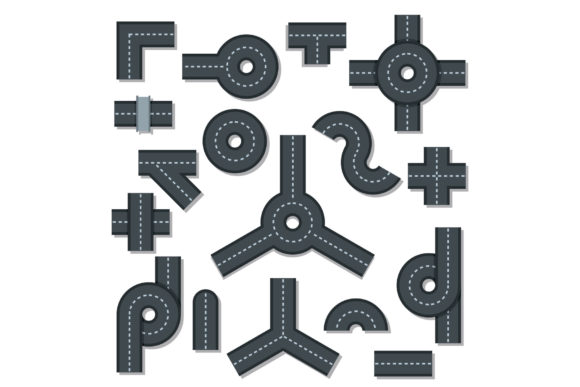
To the uninitiated, a road might just look like a gray line on a screen. However, in the realm of professional graphic design and UI/UX development, a road is a composite of various parts. A Road elements parts icons set is a curated library of vector graphics that deconstructs a roadway into its constituent components. Instead of providing a single, static image of a highway, these sets offer modular pieces that can be assembled, rearranged, and customized to fit specific narrative or functional needs.
Typically, such a set features a flat illustration style. This design choice is intentional. Flat design removes unnecessary textures, gradients, and shadows, focusing instead on clean lines, bold colors, and clear shapes. This aesthetic ensures that the icons remain legible even when scaled down to tiny sizes on a mobile device or blown up for a large presentation screen. The "16 road elements" usually found in a standard pack might include:
- Straight road segments (horizontal and vertical)
- Curved road sections for turns
- T-intersections and cross-intersections
- Road dividers and median strips
- Pedestrian crossings (zebra crossings)
- Traffic islands and roundabouts
- Stop lines and yield markings
- Shoulder markings and lane indicators
By having these individual parts, a designer is no longer limited to pre-drawn maps. They become architects of their own visual narratives, capable of constructing any road scenario imaginable.
The Power of Vector Formats: AI, EPS, and Beyond
One of the most significant aspects of a professional Road Elements Parts Icons Set is the file formats provided. You will often see these sets advertised with a list including JPG, EPS, AI, PSD, and PNG. While having a JPG or PNG is convenient for quick previews or immediate use in a document, the true power lies in the vector formats: AI (Adobe Illustrator) and EPS (Encapsulated PostScript).
Vector graphics are mathematically defined paths rather than grids of pixels. This means they are infinitely scalable. You can take a small icon of a curve from the set and enlarge it to the size of a billboard without losing a single ounce of quality. There is no pixelation, no blurriness, just crisp, clean lines. For web designers, this is invaluable. As screens become higher resolution (Retina displays, 4K monitors), vector assets ensure that road maps and diagrams look sharp on every device.
Furthermore, the inclusion of PSD (Photoshop) files allows for layer-based editing. This is particularly useful for designers who prefer working in Photoshop or need to add complex textures and lighting effects that go beyond the flat illustration style. The availability of multiple formats ensures that regardless of your preferred software stack—be it Adobe Creative Cloud, Affinity Designer, or open-source alternatives like Inkscape (which supports EPS/SVG)—you can integrate these road elements seamlessly into your workflow.
Practical Applications in Modern Life and Business
Why does a set of 16 road icons matter in the grand scheme of technology and business? The answer lies in the ubiquity of location-based services and the need for clear information architecture.
- Navigation and Mapping Apps: Every time you use a GPS to find the quickest route to a coffee shop, you are interacting with a digital representation of road elements. Custom icon sets allow app developers to create unique map styles that differentiate their brand from competitors like Google Maps or Waze.
- Urban Planning and Infrastructure: City planners and civil engineers use these illustrations in presentations to explain proposed changes to traffic flow, new bike lanes, or pedestrian zones to stakeholders and the public. Clear visuals help non-experts understand complex engineering proposals.
- Educational Materials: Driving schools and educational publishers use these icons to teach traffic rules. A clear, flat illustration of a roundabout or a merge lane is far more effective than a cluttered photograph when teaching a new driver the rules of the road.
- Logistics and Supply Chain: Companies tracking fleets of trucks often use dashboard visualizations. Custom road elements allow them to visualize delivery routes, bottlenecks, and distribution networks in a way that is easy for managers to digest at a glance.
In each of these scenarios, the Road elements parts icons set acts as a universal language. It transcends barriers, making complex spatial relationships understandable instantly.
Common Misunderstandings About Icon Sets
Despite their utility, there are common misconceptions about using pre-made icon sets. One frequent assumption is that using a stock set limits creativity. Critics argue that if everyone uses the same "16 road elements," all designs will look identical. However, this overlooks the modular nature of vector assets.
Because these are vector files, every color, stroke width, and shape can be modified. A designer can take a standard blue road from an AI file and change it to match their brand's corporate orange. They can widen the lanes, alter the curvature, or combine the flat icons with other design elements to create a completely unique hybrid style. The set provides the structure, but the designer provides the soul.
Another misunderstanding is regarding the file formats. Beginners often download the JPG version and try to stretch it, only to find it becomes blurry. It is essential to understand that for professional web and print work, the AI or EPS files are the primary assets. The raster formats (JPG/PNG) are merely exports for specific, non-editable use cases.
Integrating Road Elements into Your Workflow
So, how do you actually get started with a Road Elements Parts Icons Set? The process is straightforward but requires a bit of foresight.
First, identify the scope of your project. Do you need a realistic depiction of a highway, or a stylized, gamified version of a city street? The "flat illustration" style mentioned in most sets leans towards the latter—clean, modern, and friendly. This makes it perfect for web interfaces where cognitive load needs to be minimized.
Once you have acquired the set (ensuring you have the AI, EPS, PSD, PNG, and JPG versions), import the vector files into your design software. If you are building a web interface, you might export specific combinations as SVGs (Scalable Vector Graphics), which are code-friendly and lightweight. If you are creating a static report, the high-resolution PNGs derived from the vector source will ensure print quality.
Consider the context of your audience. If you are designing for a global audience, remember that road markings can vary by country. While a flat icon set provides a generalized representation, always double-check that the direction of traffic or the style of a crosswalk aligns with the region your product serves. This attention to detail enhances the E-E-A-T (Experience, Expertise, Authoritativeness, and Trustworthiness) of your content.
The Future of Digital Infrastructure Visualization
As we move towards smarter cities and autonomous vehicles, the way we visualize road networks will become even more critical. We are moving away from static maps toward dynamic, interactive data visualizations. In this future, the humble icon set evolves. The 16 basic elements we use today might soon be animated, reacting to real-time traffic data, or integrated into Augmented Reality (AR) overlays.
However, the foundation remains the same. Before you can animate a traffic jam or simulate a self-driving car's path, you need the basic vocabulary of the road. You need the curves, the intersections, and the lanes. A well-crafted Road elements parts icons set provides this vocabulary. It empowers creators to build the visual infrastructure of tomorrow, starting with the simple, elegant lines of a flat vector icon.
In conclusion, whether you are a seasoned graphic designer or a business owner looking to improve your presentation materials, do not underestimate the power of specialized assets. A comprehensive set of road elements offers flexibility, scalability, and clarity. By leveraging the full potential of formats like AI and EPS, and understanding the modular nature of these 16 key parts, you can create compelling, informative, and visually stunning content that resonates with your audience. The road to better design starts with the right tools, and sometimes, those tools are just 16 simple vectors waiting to be connected.